
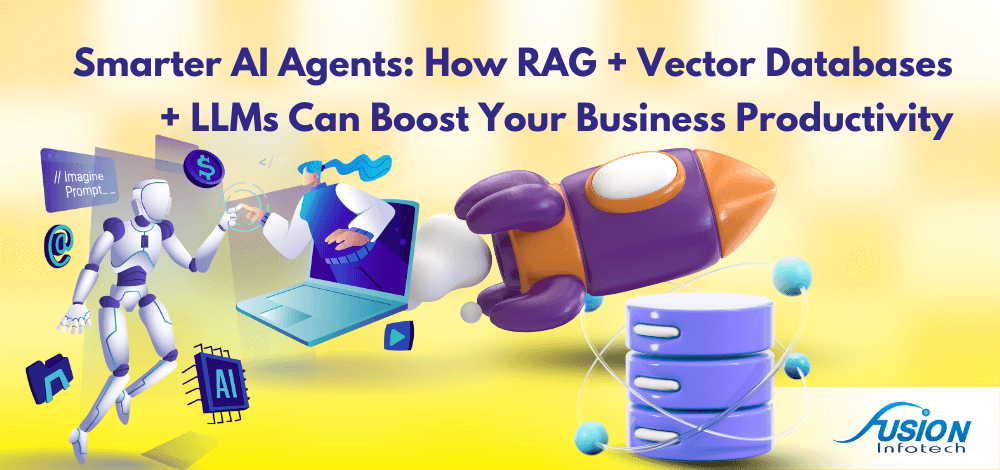
Artificial Intelligence is no longer an experimental luxury—it is the foundational engine driving operational agility, process automation, and market competitiveness. From automating ERP financial reconciliations to optimizing supply chain logistics, AI agents are actively reshaping how modern enterprises function.
However, generic Large Language Models (LLMs) suffer from a critical limitation: an AI agent is only as reliable as the data it can access. Standalone LLMs are static, trained on historical public web data, and prone to "hallucinations"—generating confident yet entirely inaccurate answers when queried about proprietary corporate knowledge.
To deploy enterprise-grade AI agents that deliver factual, audit-ready, and cost-effective outputs, modern software architecture relies on a powerful trio: Large Language Models (LLMs), Retrieval-Augmented Generation (RAG), and Vector Databases. At Fusion Infotech, we integrate these advanced AI frameworks directly into enterprise IT environments—including Oracle Cloud Infrastructure (OCI) and SAP enterprise ecosystems—turning raw corporate data into real-time operational productivity.
Standard LLMs behave like brilliant students answering an open-book exam strictly from memory based on books read last year. While knowledgeable, their answers regarding your company's latest inventory levels, NBR tax policy updates, or internal SOPs will be outdated or plain wrong.
Retrieval-Augmented Generation (RAG) solves this by giving the LLM an instant, real-time reference library. Instead of relying solely on pre-trained parameters, RAG empowers the AI model to "look up" fresh, trusted information from your private databases before constructing a response.
Traditional relational databases store data in rows and columns, searching strictly via exact keyword matches. If a user searches for "renewable power," a traditional system misses documents that discuss "solar arrays" or "wind turbines" unless those exact words are indexed.
A Vector Database searches by meaning (semantics) rather than characters.
Vector databases convert unstructured text, documents, images, and audio into multi-dimensional numerical coordinates called vector embeddings. Concepts that share semantic meaning are positioned close together within this multi-dimensional mathematical space.
When combined, RAG and Vector Databases transform Large Language Models into high-performance, context-aware AI agents designed for enterprise workloads.
+------------------+ +-------------------+ +--------------------+
| Employee Query | ----> | Vector Database | ----> | Relevant Context |
+------------------+ | (Semantic Search)| | (Text Chunks) |
+-------------------+ +--------------------+
|
v
+------------------+ +-------------------+ +--------------------+
| Accurate Output | <---- | LLM Generator | <---- | Prompt + Context |
| (Zero Distortion)| | (Gemini / OCI) | | (Augmented) |
+------------------+ +-------------------+ +--------------------+
By constraining the LLM to generate responses using only the retrieved context chunks from your Vector DB, RAG virtually eliminates fabricated facts. Answers are strictly backed by verified corporate source documents.
LLMs bill compute usage based on "tokens" (units of text). Pushing entire 500-page operational manuals into an LLM prompt is exceptionally expensive, slow, and frequently exceeds model context windows. Vector DBs pinpoint the exact 3 paragraphs required to answer a question, feeding only those condensed lines into the LLM prompt—dramatically reducing token consumption and processing latency.
Passing your entire corporate database into a public LLM poses severe data privacy risks. With a localized RAG framework running on enterprise environments like Oracle Cloud Infrastructure (OCI) Generative AI or private cloud clusters, your proprietary enterprise data never leaves your secure security perimeter. Role-based access controls ensure users only retrieve information they are explicitly authorized to view.
Enterprise AI agents powered by RAG and Vector DBs deliver immediate productivity gains across key organizational functions:
What is the difference between fine-tuning an LLM and using RAG?
Fine-tuning retrains the internal weights of an LLM, which is expensive, slow, and permanent. RAG keeps the underlying LLM unchanged and instead feeds it real-time external data at the moment of query. RAG is significantly cheaper, faster to update, and more flexible for rapidly changing corporate data.
Is my company data safe when using RAG with Vector Databases?
Yes, provided the system is architected on enterprise-grade infrastructure. When Fusion Infotech deploys RAG solutions on OCI Generative AI or secure cloud environments, your data is encrypted at rest and in transit, governed by strict access permissions, and never used to train public foundation models.
Can RAG connect directly with our existing SAP or Oracle ERP software?
Absolutely. RAG architectures interact directly with enterprise APIs, relational SQL databases, vector databases, and document repositories—unifying structured ERP databases with unstructured enterprise files into a single conversational AI interface.
Deploying autonomous, accurate AI agents requires a deep understanding of enterprise data architectures, cloud infrastructure, and core business processes.
As a premier digital transformation authority in Bangladesh and South Asia, Fusion Infotech provides end-to-end consulting, architecture blueprinting, and implementation for RAG pipelines, Vector Databases, and enterprise LLM integrations.
Whether you are seeking to integrate intelligent AI workflows into Oracle Cloud Infrastructure, optimize SAP Business One data access, or automate workforce operations with WorkedIn, our enterprise technology specialists deliver custom, high-ROI AI transformations.
Ready to transform your business data into intelligent, actionable AI productivity? Contact the senior technology architects at Fusion Infotech today to schedule your enterprise AI blueprinting session.


.svg)
© 2025 Fusion Infotech Ltd. All rights reserved.



.png)
