
Navigating the landscape of enterprise software can be challenging for corporate leaders and IT decision-makers. When evaluating Tier-1 Enterprise Resource Planning (ERP) platforms, two global technology giants consistently dominate the discussion: SAP and Oracle.
Both platforms power many of the world's largest conglomerates and mid-market enterprises. However, choosing between SAP and Oracle requires evaluating architectural differences, deployment models, total cost of ownership (TCO), and local operational requirements—such as National Board of Revenue (NBR) statutory VAT compliance in regional markets like Bangladesh.
At Fusion Infotech, as a certified SAP Partner and premier Oracle solutions consultant, we deliver end-to-end ERP implementation, infrastructure architecture, and digital transformation services. In this comparative guide, we examine the evolution, core strengths, functional capabilities, and strategic considerations of SAP and Oracle to help your organization make an informed choice.
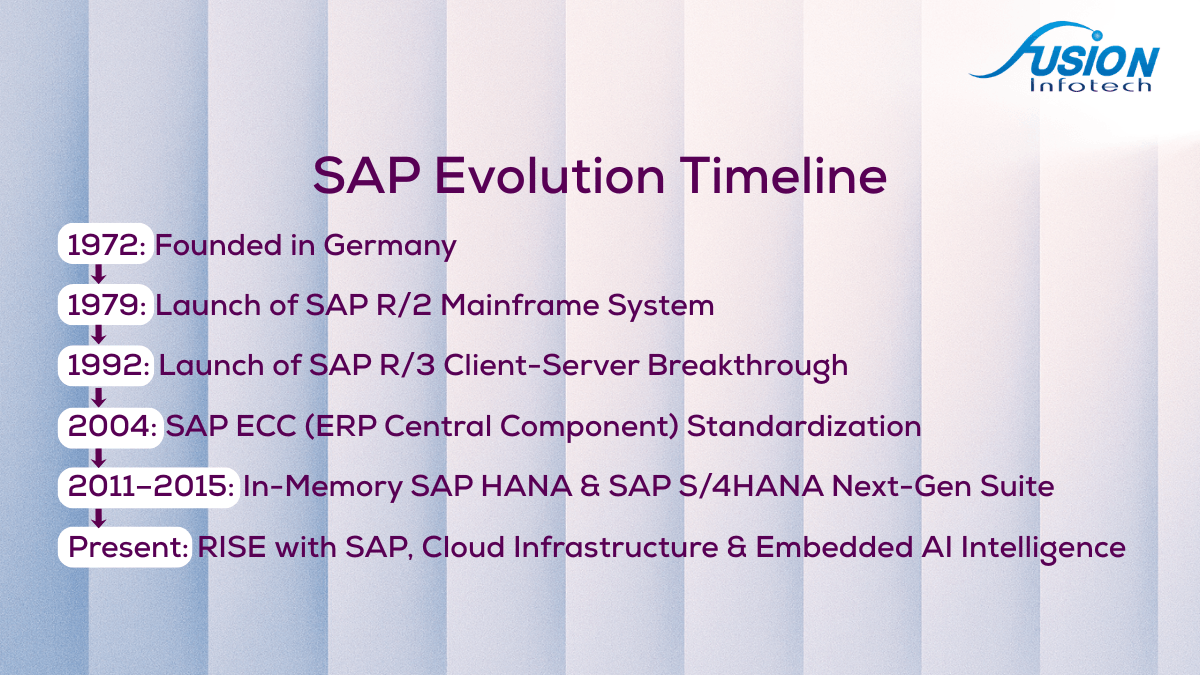
Founded in 1972 in Weinheim, Germany, by five former IBM engineers, Dietmar Hopp, Hasso Plattner, Klaus Tschira, Claus Wellenreuther, and Hans-Werner Hector, SAP (Systems, Applications, and Products in Data Processing) was built on a vision: enabling enterprise operations in real time.
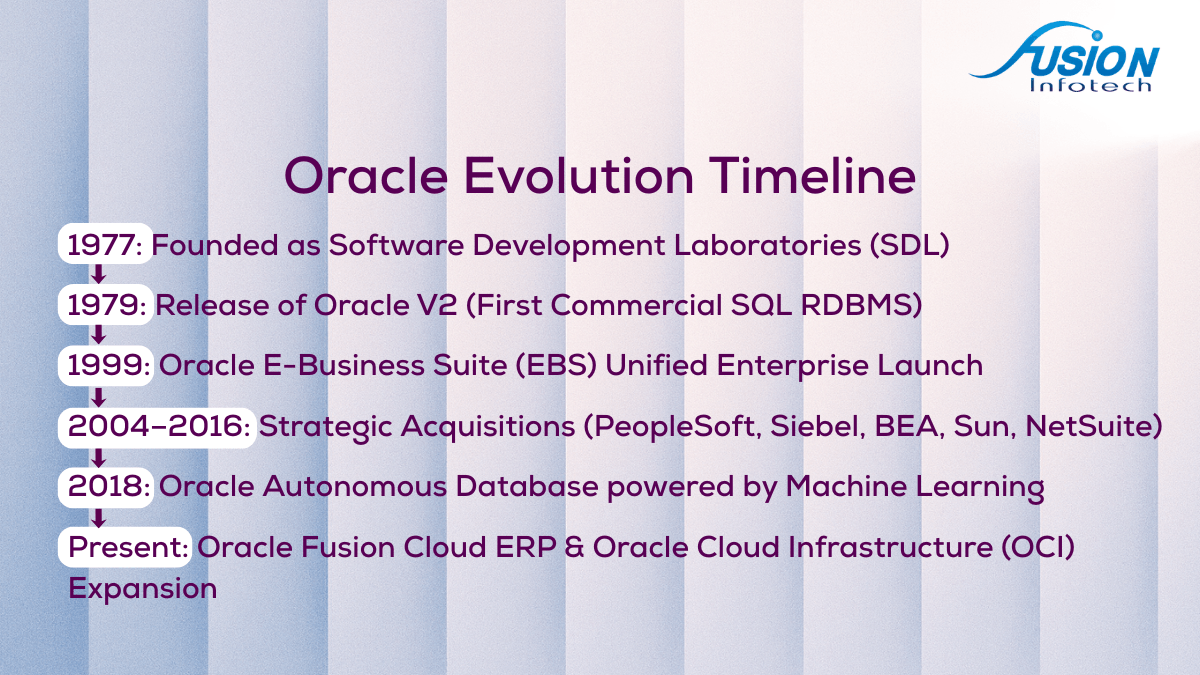
Oracle Corporation was founded in 1977 in Santa Clara, California, by Larry Ellison, Bob Miner, and Ed Oates under the initial name Software Development Laboratories (SDL). Their mission was to develop a commercial Relational Database Management System (RDBMS) based on Structured Query Language (SQL).
While both SAP and Oracle cover end-to-end business management, their structural designs, operational philosophy, and technical strengths differ:
SAP’s architecture allows organizations to build highly structured operational models. From supply chain execution to materials management (MM), financial control (FICO), and production planning (PP), SAP enforces strict operational controls that minimize transactional errors in complex multi-unit businesses.
SAP’s HANA platform processes analytical data directly within RAM rather than pulling from traditional disk databases. This eliminates separate data warehousing overhead for routine reports, allowing leadership teams to evaluate inventory valuations, gross margins, and live production bottlenecks instantly.
SAP offers extensive pre-configured industry templates that incorporate sector-specific regulatory standards, batch-tracing capabilities, and compliance rules. For enterprises operating in Bangladesh, this includes native alignment with National Board of Revenue (NBR) statutory VAT reporting requirements.
Oracle’s enterprise applications leverage Oracle Cloud Infrastructure (OCI) and Oracle Autonomous Database technology. Self-driving, self-securing database management reduces manual database administrator (DBA) overhead while maintaining high transaction throughput and automated security patching.
Through platform acquisitions and continuous core software development, Oracle offers seamless convergence across Customer Relationship Management (CRM), Enterprise Resource Planning (ERP), and Human Capital Management (HCM). Similarly, SAP provides unified operations by connecting core engines with specialized platforms like WorkedIn HRMS or SourceCore procurement solutions.
When selecting between SAP and Oracle, executive leadership teams should evaluate four critical factors:
+-----------------------------------+
| ERP Selection Decision Matrix |
+-----------------------------------+
|
+-----------------+------------+------------+-----------------+
| | | |
v v v v
+----------+ +---------------+ +---------------+ +-----------+
| Business | | Total Cost of | | Implementation| | Local Tax |
| Model | | Ownership | | Timeline | | Compliance|
| Depth | | (TCO) | | & Complexity | | (NBR VAT) |
+----------+ +---------------+ +---------------+ +-----------+
Implementation duration depends on organizational complexity, data quality, scope, and customization levels rather than vendor brand alone. Cloud-first solutions (such as SAP Business One or NetSuite) typically deploy faster than multi-module enterprise suites (such as full-scale S/4HANA or Oracle EBS).
Historically, legacy SAP ECC environments often ran on third-party databases, including Oracle. However, modern SAP S/4HANA runs exclusively on SAP's proprietary, high-performance SAP HANA in-memory database platform.
Both platforms can handle international taxation standards. However, ensuring full compliance with Bangladesh's National Board of Revenue (NBR) VAT and tax frameworks requires working with certified regional consultants, such as Fusion Infotech, who integrate proven local compliance modules directly into the ERP core.
There is no single "winner" in the comparison between SAP and Oracle. The optimal choice depends on your specific business processes, growth velocity, operational model, and long-term IT strategy. SAP offers unmatched operational precision, in-memory processing speed, and deep industry templates, while Oracle delivers strong cloud-native infrastructure, unified application suites, and autonomous database capabilities.
As a leading digital transformation authority and certified enterprise consulting partner in Bangladesh, Fusion Infotech brings years of hands-on implementation experience across both SAP and Oracle ecosystems. Our senior software architects help growing SMEs and large conglomerates evaluate their business requirements, select the right ERP framework, and execute seamless digital transformations.
Ready to select and deploy the ideal ERP platform for your enterprise? Contact the certified enterprise solution architects at Fusion Infotech today to schedule a comprehensive ERP blueprinting session.


.svg)
© 2025 Fusion Infotech Ltd. All rights reserved.





.png)
