
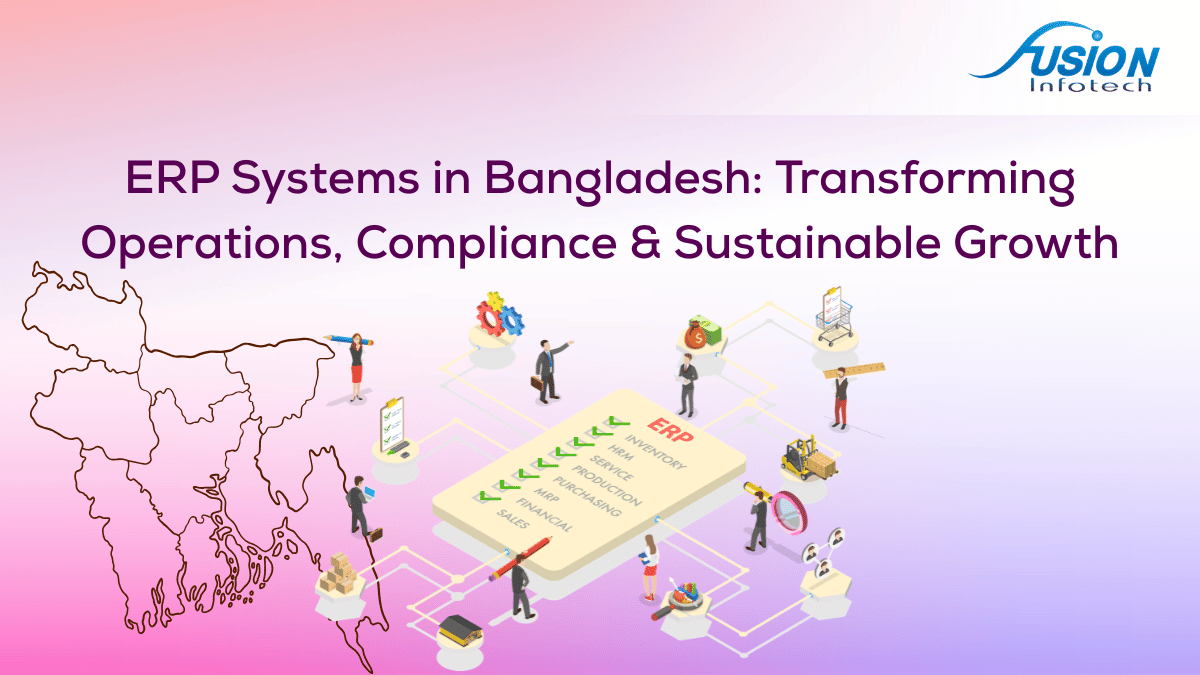
The commercial landscape in Bangladesh is undergoing a rapid digital evolution. Driven by expanding manufacturing capacity, complex regional supply chains, and evolving regulatory mandates from the National Board of Revenue (NBR), businesses across Dhaka, Chattogram, Gazipur, and Narayanganj can no longer rely on fragmented spreadsheets or legacy software.
Enterprise Resource Planning (ERP) systems have emerged as essential technology foundations for organizations striving to maintain competitiveness, enforce internal controls, and maximize profit margins. By unifying core functions—including financial accounting, sales order management, warehouse inventory, procurement, and human capital—into a single source of truth, modern ERP platforms allow local enterprises to operate with speed, agility, and precision.
At Fusion Infotech, Bangladesh’s premier certified SAP technology authority and enterprise digital transformation partner, we equip organizations ranging from growing small and mid-sized enterprises (SMEs) to large industrial conglomerates with world-class ERP architectures tailored specifically to the regional market.
Enterprise Resource Planning (ERP) is an integrated software platform engineered to coordinate, automate, and manage an organization's core business processes within a unified database architecture.
Instead of operating isolated software tools for accounting, inventory, sales, and payroll, an ERP system acts as a central neural network. It ensures seamless data flow across departments, providing real-time operational visibility and establishing a single, immutable source of corporate data.
Modern ERP platforms—such as SAP Business One—are flexible, adaptable, cost-effective, and engineered to deliver rapid response times across on-premise, private cloud, or hybrid cloud environments.
Operating in Bangladesh's $450+ billion economy presents distinct operational opportunities and complex challenges. Enterprise leaders must manage currency volatility, port logistics bottlenecks, strict raw material sourcing schedules, and changing statutory tax requirements.
Deploying an integrated ERP solution addresses these challenges directly:
Implementing an enterprise ERP solution through Fusion Infotech provides distinct commercial advantages:
                     [ Centralized ERP Platform ]
                                   │
      ┌────────────────────────────┼────────────────────────────┐
      ▼                            ▼                            ▼
[ Process Efficiency ]      [ Executive Intelligence ]    [ Automated Compliance ]
 (Automated Workflows)        (Real-Time Analytics)       (NBR VAT & Audit Trails)
ERP systems automate repetitive administrative workflows, eliminating redundant manual efforts. By standardizing process flows across procurement, production, and sales, organizations execute daily operations significantly faster.
Provides C-suite executives and board members with immediate, live access to financial statements, sales trends, margin analysis, and inventory valuations. Real-time visual dashboards replace historical guesswork with precise operational intelligence.
By removing manual data reconciliation tasks between sales and accounting, staff members spend less time fixing data entry errors and more time on high-value strategic initiatives, customer engagement, and business development.
Gives complete visibility into working capital allocation, raw material consumption rates, and machinery run-times. Identifying bottlenecks and surplus inventory allows businesses to reduce stock holding costs and optimize cash flow.
Centralized data management breaks down departmental communication barriers. Sales representatives can check live available-to-promise (ATP) inventory levels, while production managers view live customer sales orders to align manufacturing schedules instantly.
Built-in compliance logic ensures adherence to Bangladesh labor laws, financial accounting standards (IFRS), National Board of Revenue (NBR) tax codes, and sector-specific guidelines (such as DGDA and cGMP in life sciences).
As your enterprise grows, adding new factory sites, distribution hubs, international offices, or product lines requires no structural software redesign. Scalable cloud ERP platforms expand seamlessly alongside your corporate footprint.
Different sectors require specialized ERP functional modules to address unique operational demands:
Selecting the appropriate ERP deployment architecture is critical for aligning technical performance with organizational capabilities:
Many Bangladeshi enterprises face common operational friction points: manual ledger reconciliations, inaccurate inventory counts, delayed customer quotes, and unorganized sales pipelines.
Implementing a centralized ERP system directly resolves these operational hurdles:

In Bangladesh's growing tech market, generic accounting software or basic sales tools often claim to provide complete enterprise control. However, genuine enterprise ERP platforms like SAP Business One, implemented by Fusion Infotech, stand far apart from basic sales tools:
             [ Generic Sales / Local Accounting Software ]
              (Isolated DB, Manual Tax Calculations, No MRP)
                                   VS
               [ SAP Business One Enterprise Platform ]
              (In-Memory Analytics, Automated NBR VAT, WMS/MRP)
Depending on company size, system scope, and business process complexity, an SAP Business One implementation typically ranges from 8 to 16 weeks for standard configurations, moving through blueprinting, data migration, user training, and go-live support.
Yes. Modern Cloud ERP platforms utilize lightweight, bandwidth-optimized web interfaces and secure mobile apps that run smoothly on standard high-speed broadband and 4G/5G mobile data networks.
Fusion Infotech provides fully localized NBR compliance modules built directly into SAP Business One. The platform automatically calculates VAT, SD, and TDS schedules, generating official NBR Mushak 6.3 tax invoices, Mushak 9.1 return summaries, and statutory audit reports.
Fusion Infotech combines certified SAP expertise, proprietary cloud infrastructure, localized compliance tools, and deep industry knowledge across manufacturing, trading, retail, and life sciences to ensure successful enterprise digital transformation.
As commercial competition intensifies and transaction speeds accelerate across Bangladesh, operating on disconnected legacy tools or manual processes introduces severe operational risk. Adopting a centralized ERP system is the most effective strategic step an enterprise can take to safeguard profit margins, ensure total regulatory compliance, and position itself for sustainable long-term growth.
By unifying financial management, supply chain logistics, warehouse inventory, and sales operations onto a single cloud-ready platform, SAP Business One turns operational complexity into a distinct competitive advantage.
Ready to modernize your business operations and achieve enterprise digital excellence? Partner with Fusion Infotech—Bangladesh’s premier certified SAP implementation authority.
Contact our senior enterprise consulting team at Fusion Infotech today to schedule your comprehensive ERP blueprinting session and live demonstration.


.svg)
© 2025 Fusion Infotech Ltd. All rights reserved.







.png)
